CNC milling vs turning is the first routing decision for almost every machined part. Both processes remove metal with precision, and both run on modern CNC equipment. But they move differently. Milling spins the cutting tool while the part stays fixed. Turning spins the part while the tool feeds into it. That single difference decides which geometries, tolerances, and costs each process suits best.
This guide walks through CNC milling vs turning fundamentals and compares capabilities in general ranges. Then it shows how to split a part family between the two.
CNC Milling vs Turning: The Fundamental Difference
The whole CNC milling vs turning comparison starts with motion. In a milling machine, the workpiece clamps to a table or fixture. A rotating cutter then moves across it and shears material away. Three-axis mills move the cutter in X, Y, and Z. Four- and five-axis machines add rotary axes, so the cutter can reach five or more faces of a part in a single setup.
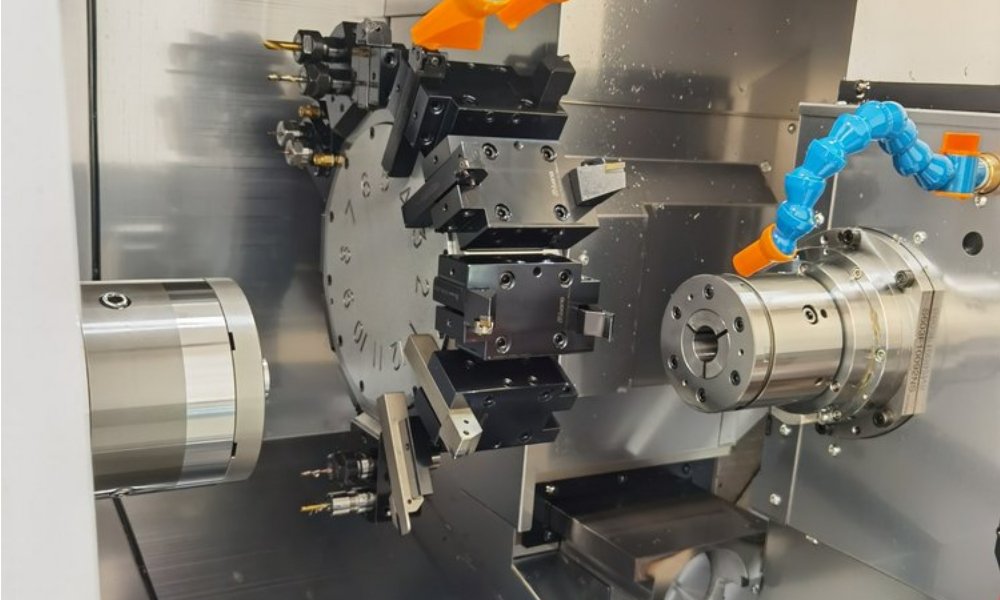
In a lathe, the roles reverse. The workpiece spins in a chuck or collet, often at thousands of RPM. A stationary cutting tool feeds into the rotating material and removes chips. Turning creates cylinders, cones, grooves, threads, and faces, all features with rotational symmetry. For round parts, our CNC turning service covers everything from bar work to chucked blanks.
In short, milling shapes the block, and turning shapes the round.
Which Geometry Suits Which Process
In the CNC milling vs turning debate, geometry settles most arguments. Choose turning when round features dominate the part: shafts, bushings, nozzles, fittings, spacers, and valve bodies. If you can describe the part by its cross-section swept around an axis, a lathe will produce it fast and accurately.
Choose milling for prismatic parts: brackets, housings, manifolds, plates, and mold inserts. Pockets, slots, bosses, and hole patterns across multiple faces are milling territory, and our CNC milling service handles them from one-offs to repeat batches. As a rule of thumb, parts whose features are rotationally symmetric belong on a lathe. Everything else starts on a mill. For example, a hydraulic manifold with intersecting bores and mounting pockets belongs on a mill. Meanwhile, a drive shaft with bearing journals and a keyway belongs on a lathe.
Tolerances and Surface Finishes: General Ranges
Both processes achieve high precision, but the CNC milling vs turning balance shifts by feature type. Standard milling holds about plus or minus 0.05 mm on most dimensions, and careful finishing passes reach plus or minus 0.01 mm on critical features. Surface finishes typically land between Ra 1.6 and Ra 3.2 straight off the machine, and better with fine passes.
Turning matches or beats those numbers on diameters. A finished turned diameter commonly holds plus or minus 0.02 mm to 0.05 mm, and precision turning reaches the low microns. Because the tool rides the same axis as the part, concentricity comes naturally. Surface finishes of Ra 0.8 to 1.6 are routine, and nonferrous metals can finish even brighter. Threads also favor turning, since single-point threading on a lathe produces clean, gauge-ready threads in one setup.
Cost Behavior: Where Each Process Wins
Cost behavior is where CNC milling vs turning differences hit the budget hardest. Turning is usually cheaper per part for rotational parts. Setup is quick, cycle times are short, and one operator can supervise several machines. Bar-fed lathes and Swiss-type machines push that economy further on long runs of small parts.
Milling costs more per machine hour, but it is the only economical route for complex prismatic parts. Costs climb with the number of setups. A part that needs three re-fixturing steps costs far more than one finished in a single five-axis setup. Quantity affects the two processes differently too. Turning amortizes fastest at volume, while milling stays flexible from one-offs upward. Before ordering, talk through your drawing with your machine shop to lock in the cheapest legal route. In addition, chip volume matters. Turning a round part from bar stock removes less material than milling the same part from a block, which saves both stock cost and chip disposal cost.
Mill-Turn and Combined Approaches
Modern machines blur the CNC milling vs turning line. A mill-turn center is a lathe with live tooling: driven tools that mill, drill, and tap while the part spins or holds position. One machine can complete a shaft with a flat, a cross hole, and a keyway in a single setup. For parts that are 80 percent turned and 20 percent milled, mill-turn often beats two separate operations on both price and accuracy. However, mill-turn centers cost more per hour, and programming them takes care. For simple parts, two conventional operations often stay cheaper.
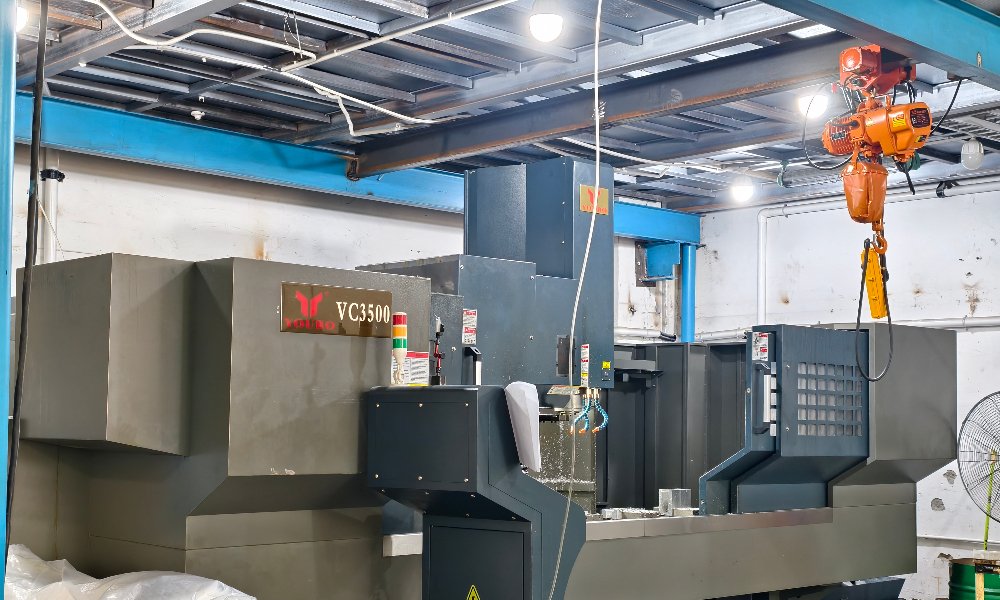
The same logic scales up. You can rough-turn a blank, mill the off-axis features, and finish-turn the bearing seats. Your supplier’s equipment mix decides which combination is cheapest. XAP Precision runs turning, milling, Swiss-type, and gantry machines, so each part routes to the process rather than the other way around.
How Buyers Should Split a Part Family
Buyers rarely order one part in isolation. Here is a practical way to divide a family:
- First, sort by shape. Rotationally symmetric parts go to the lathe, and prismatic parts go to the mill.
- Second, group by size. Small, slender parts suit Swiss-type turning, while larger rounds suit conventional lathes.
- Third, flag hybrids. Parts with turned bodies and off-axis features may fit mill-turn or need two operations.
- Fourth, unify tolerances. Assign tight tolerances only to functional surfaces, so either process can hit them cheaply.
Finally, review the split against your supplier’s equipment list. The right answer to CNC milling vs turning often depends on which machines actually sit on the shop floor.
Frequently Asked Questions About CNC Milling vs Turning
Can a lathe produce square or off-axis features?
Not directly. Lathes produce round features, so flats, keyways, and off-axis holes need milling or a secondary operation. Mill-turn machines with live tooling can add light milling in the same setup, but heavy prismatic work belongs on a machining center.
Which process is cheaper for 500 bushings?
Turning, almost always. Bushings are rotationally symmetric, so a lathe finishes each part in seconds with minimal setup cost. Milling the same shape from block stock would waste material and machine time. In CNC milling vs turning cost comparisons, round parts nearly always route to the lathe.
What tolerances can I expect from each process?
Standard milling holds about plus or minus 0.05 mm, and turning holds similar or tighter values on diameters. Precision finishing can push both into the low microns. Always mark critical dimensions on your drawing so the shop can plan the right sequence of operations.
Route Your Part Family With Confidence
Ready to route your parts? Send XAP Precision your drawings and quantities, and we will assign each feature to the right process, CNC milling vs turning decisions included. Every inquiry receives a free quote and free DFM feedback. Contact us today and get a detailed proposal within one business day.