The cross-hatched bands on knobs, thumbscrews, and gauge handles come from CNC knurling, a process that forms or cuts a raised pattern onto a cylindrical surface. In addition, CNC knurling adds grip, compensates for press-fit dimensions, and gives parts a crisp, tactile finish. Done well, a knurl feels precise and wears for years. When it goes wrong, the process tears the material and scrapes the diameter. This guide covers pattern types, forming versus cutting methods, material selection, and the design rules that produce clean knurls.
What CNC Knurling Does for a Part
CNC knurling solves three design problems at once. First, grip. Raised teeth bite into fingertips, so knobs and adjustment screws stay controllable with wet or oily hands. Medical instruments and hand tools rely on that every day. Second, dimension rescue. Forming a knurl raises the effective diameter of a shaft by a controlled amount, which salvages slightly undersized press fits without rework. Third, appearance. A crisp diamond pattern reads as quality and gives consumer parts a finished, branded feel.
In fact, the press-fit trick deserves a closer look. A shaft that measures a few hundredths of a millimeter under its target can be knurled back into spec, because the displaced metal raises the effective diameter. The repair is quick and cheap. However, it only suits light loads, since the raised peaks can flatten under heavy torque or repeated sliding.
Knurl Pattern Types: Straight, Diamond, and Helical
Notably, pattern choice follows function. Diamond knurls cross two angled sets of lines, usually at 30 or 45 degrees, and they provide multidirectional grip. Therefore they dominate knobs and handles. In contrast, straight knurls run parallel to the part axis and give strong axial bite, which suits push-pull grips and some press-fit repairs. Helical knurls wrap the surface in a single spiral, left- or right-handed. Meanwhile, that continuous line hides tool marks and feels smoother under rotation, so it appears on throttle sleeves and decorative collars.
In addition, pattern depth matters as much as geometry. A shallow knurl looks fine at first but wears smooth quickly, while an over-deep pattern collects dirt and feels sharp. Shops therefore aim for a standard tooth height tied to the pitch, and they verify the result against the post-knurl diameter.
Forming vs. Cutting: How CNC Knurling Makes the Pattern
Forming knurls displace material instead of removing it. A hardened wheel rolls against the rotating part under heavy pressure and squeezes metal up into the pattern. Because no chips form, the process runs fast, and the work-hardened surface resists wear. However, forming raises the diameter, typically by around 0.25 mm on medium pitches, and it demands a rigid setup. Consequently, most CNC knurling on turned parts uses forming. Our CNC turning service supplies the lathes and tooling behind it.
Cutting knurls work like tiny gear cutters, shearing material away to leave the pattern standing proud. They generate far less radial force and disturb the diameter much less. Consequently, cutting knurls suit hard materials, thin walls, and plastics that would deform under forming pressure. However, the pattern stays slightly less sharp, and cycle time runs longer, but the control is worth it on difficult jobs.
Where CNC Knurling Happens: Lathe Versus Machining Center
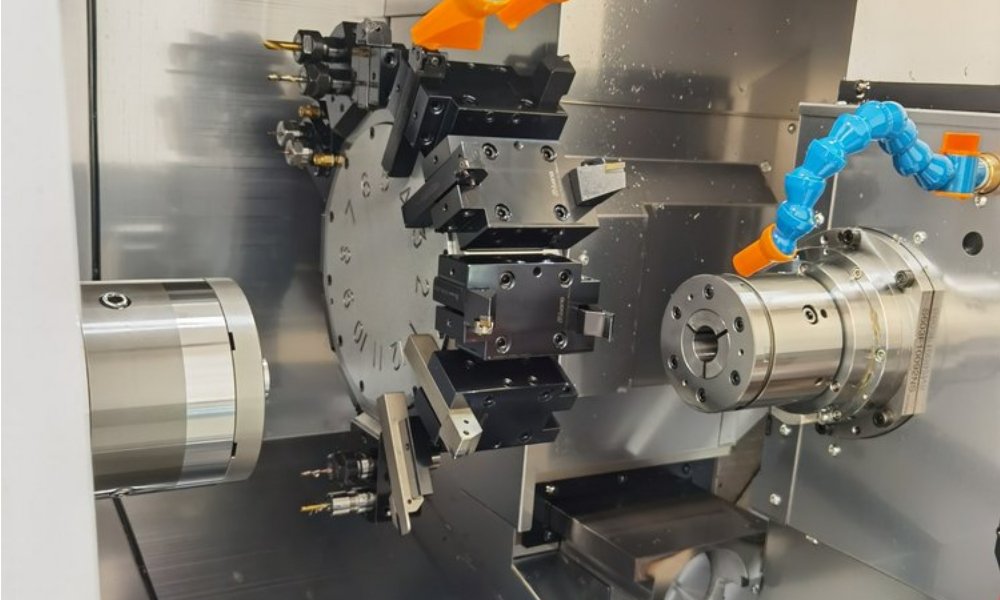
Most CNC knurling happens on lathes, where the part spins and the knurl tool feeds in under controlled pressure. As a result, that arrangement gives the even surface speed that clean patterns need. Machining centers can knurl too, using dedicated rolling heads, but they mostly add patterns to features that cannot be turned, such as bosses beside a milled flat. For production runs of round parts, however, the lathe stays faster and cheaper per part. That is why knurled knobs and screws usually start as turned blanks.
Materials That Knurl Well, and Ones to Avoid
Ultimately, material decides how a CNC knurling job turns out. Ductile metals with uniform structure perform best. Aluminum 6061 and 7075 form clean patterns at moderate pressure. Brass is the standout: its free-machining grades produce sharp, burr-free teeth, which is why brass CNC machining supplies so many knurled fittings, inserts, and thumbscrews. Stainless steels knurl well but demand rigid setups because they work harden during the roll.
In contrast, the other side of the list holds materials to avoid. Soft plastics such as PTFE, polyethylene, and soft PVC smear and cold-flow, so the pattern flattens within weeks of use. Hardened or very tough steels need cutting knurls and slow feeds, and many shops knurl before hardening for that reason. Cast iron accepts a knurl but edges can chip, so keep patterns coarse there.
Design Rules for CNC Knurling: Pitch, Band Width, and Edge Relief
Clean CNC knurling starts on the drawing. The rules below cover the details shops check first.
- Match pitch to diameter. Fine pitches of 0.8 to 1.2 mm suit parts under about 12 mm, while larger parts carry medium and coarse pitches. Too coarse a pitch on a small part tears the material.
- Give the band real width. A grip zone narrower than 3 to 4 mm feels unfinished and shows every tool mark. Wider bands also tolerate pattern runout at the ends.
- Provide edge relief. An undercut groove or chamfer at each end of the band lets the tool exit cleanly, which prevents raised burrs at the shoulder.
- Account for diameter growth. Forming adds roughly half a pitch to the diameter, so dimension the knurled section accordingly and note it on the print.
- Keep knurls off critical faces. Bearing seats, sealing lands, and threads need smooth, undisturbed surfaces.
Specify the pattern plainly. “45-degree diamond knurl, 1.2 mm pitch” tells the shop everything it needs. Referencing ANSI B94.6 works too. However, a plain callout travels faster through quoting.
Frequently Asked Questions About CNC Knurling
How much does CNC knurling add to part cost?
On a turned part, a standard knurl usually adds only seconds of cycle time and one tool, so the charge stays modest. Costs rise with large diameters, hard materials, and tight control of the post-knurl diameter. Ultimately, choosing a formed knurl instead of a cut one, whenever the material allows, is the simplest saving.
How do I specify a knurl on my drawing?
Name the pattern, angle, and pitch, for example “45-degree diamond knurl, 1.2 mm pitch.” Then dimension the band location and note whether the knurled diameter is functional for a press fit. XAP Precision can recommend pitch and method during free DFM feedback, which keeps your CNC knurling callout realistic and affordable.
Can plastic parts be knurled?
Sometimes. Rigid plastics like POM, nylon, and PC accept shallow cut knurls, although the pattern stays less crisp than on metal. Soft or greasy plastics such as PTFE and polyethylene tend to smear, so grip fades quickly. For those materials, molded texture or a metal insert delivers better long-term performance.
Add Grip and Polish to Your Turned Parts
Knurls are small features with an outsized effect on how a part feels and functions. XAP Precision produces CNC knurling on turned parts in aluminum, brass, stainless steel, and engineering plastics, from prototypes through low-volume production under an ISO 9001 quality system. Share your drawing through the contact page to receive a free quote and free DFM feedback on your knurl design.