Sourcing precision components for medical devices is a high-stakes task. A single out-of-spec part can delay a product launch or put patients at risk. That is why medical CNC machining demands tighter controls than most other manufacturing work. In this guide, you will learn what medical CNC machining covers and which materials dominate. You will also see the quality expectations and how to launch your next project with confidence.
What Medical CNC Machining Covers
Medical CNC machining spans a broad range of components. However, they all share one trait. Each part must meet strict specifications and deliver reliable repeatability. In practice, that means controlled processes, documented checks, and stable tooling. Common examples of medical CNC machining work include:
- Surgical instruments such as forceps, retractors, scissors, and scalpel handles
- Device housings and enclosures for monitors, pumps, and diagnostic tools
- Implant components, trial fixtures, and instrumentation for orthopedic sets
- Endoscope parts, camera assemblies, and slender optical tubes
- Connectors, fittings, manifolds, and fluid-path bodies
In other words, this category is wide. Yet every medical CNC machining job still needs careful process planning and inspection. That breadth is part of what makes the field so demanding. Fortunately, the right machining partner can manage this complexity for you.
Compared to molding or casting, CNC machining offers tighter tolerances and faster turnaround. It also skips costly tooling, which helps during design changes. These traits make the process ideal for verification builds and short production runs. In short, teams gain speed without giving up precision.
Materials That Matter in Medical CNC Machining
Material choice drives both performance and machinability. In medical CNC machining, 316L stainless steel is a common starting point. It resists corrosion and survives repeated sterilization cycles. Titanium Grade 5 offers high strength at low weight, so it suits implants and surgical tools. Meanwhile, PEEK is a strong plastic that tolerates autoclave heat. It also appears in spinal cages and dental components. You can learn more about this polymer in our PEEK precision machining guide.
In addition, POM, ABS, PTFE, and acrylic serve housings, seals, and low-friction parts. Each plastic brings its own strengths. Ultimately, the right alloy or polymer depends on the role of the part inside the device. A good machine shop will help you weigh strength, sterility, and cost together.
Beyond raw properties, biocompatibility matters for parts that contact the body. Certain material grades are preferred for implant-adjacent uses. Therefore, ask your supplier for material certificates and full traceability. This paperwork protects you during audits and design reviews.
Some of these materials are tough to cut. Titanium, for instance, conducts heat poorly and can gall on the tool. PEEK needs sharp tooling to avoid melting or burrs. Therefore, experience with these specific stocks separates a good shop from a great one.
Tolerances and Surface Finish in Medical CNC Machining
Medical parts often run to tight tolerances, sometimes within a few microns. Surface finish matters just as much. A smooth surface resists bacteria and cleans more easily during sterilization. Therefore, many device makers specify fine finishes and tight geometric controls. These details define good medical CNC machining. A rough or porous surface, in contrast, can trap contaminants and compromise the device.
Notably, these demands shape how a shop machines the part. Tool selection, fixturing, and cut strategy all change. In fact, secondary operations like polishing, passivation, or bead blasting may follow. That is why clear drawings and finish callouts speed up quoting and production.
To verify these specs, shops use CMMs, optical comparators, and surface testers. A capable partner documents each check and ties results to specific features on your drawing. As a result, you can trace any measurement back to its source.
Design choices also affect what tolerances are realistic. Deep pockets, thin walls, and tiny threads cost more to hold. Therefore, involve your machining partner early. A quick design review can relax a non-critical tolerance and save money without hurting function.
Swiss-Type Turning for Small Precision Parts
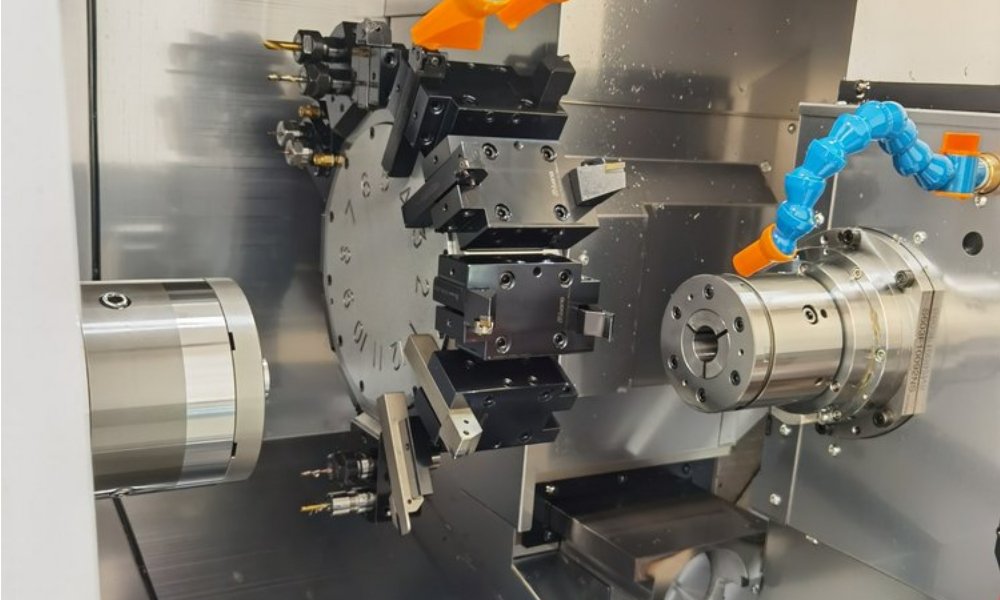
Many medical components are small, slender, and delicate. Think of guidewires, bone screws, and connector pins. Swiss-type lathes excel at this work. They support the bar stock close to the cut, which reduces deflection. As a result, they hold tight tolerances on long, thin features. This makes Swiss-type turning a cornerstone of medical CNC machining for micro parts.
Moreover, Swiss machines can mill, drill, and turn in one setup. This cuts handling and improves consistency across large lots. Read more about this capability in our Swiss-type lathe machining overview. For tiny, complex parts, it is often the fastest route to stable quality and fair pricing.
So when should you choose Swiss-type over a standard lathe? The answer depends on part size and length-to-diameter ratio. Long, thin parts benefit most from the guide bushing support. Shorter, stubby parts may do fine on a conventional turning center. A good shop will recommend the right tool for each geometry.
Quality Expectations in Medical CNC Machining
The medical industry leans on documented proof. Buyers expect full traceability from raw material to finished part. They also want inspection reports, material certificates, and lot records. In many cases, ISO 13485 is the benchmark quality standard for device manufacturers. It builds on ISO 9001 and adds device-specific controls for risk and validation. You can review the official standard on the ISO website. Knowing these expectations helps you set clear requirements up front.
At XAP Precision, we run an ISO 9001 quality system. We provide full inspection reports and material documentation with each order. Therefore, you get the records your quality team needs without extra back-and-forth. These records are the backbone of medical CNC machining, and we treat them as a standard part of delivery.
Cleanliness and packaging matter too. Parts bound for medical assembly often ship in sealed bags with lot labels. Clear labeling keeps traceability intact all the way to the production floor. It also speeds incoming inspection on your side.
When you audit a potential supplier, look for clear inspection records and calibrated equipment. Ask how they handle nonconforming parts and change control. A disciplined medical CNC machining partner will welcome these questions and answer them quickly.
Frequently Asked Questions About Medical CNC Machining
Which materials are common in medical CNC machining?
316L stainless steel, titanium Grade 5, and PEEK lead the list. 316L survives repeated sterilization. Titanium suits implants and surgical tools, while PEEK handles autoclave heat with low weight.
Does a medical CNC machining shop need ISO 13485?
Device makers usually carry ISO 13485 themselves. Machining suppliers often run ISO 9001 with full traceability and inspection reports. Confirm the documentation your quality system requires before ordering.
What tolerances can medical CNC machining hold?
Swiss-type lathes and precision milling routinely hold a few microns on small features. The practical limit depends on part size, material, and geometry. A DFM review confirms what is realistic for your design.
How to Start a Medical CNC Machining Project
Starting a medical CNC machining project does not have to be hard. First, share your drawing or 3D model. Next, note the material, tolerances, and any surface or cleanliness needs. Then, tell us the expected quantity and timeline. The more detail you provide, the faster and more accurate your quote will be.
Many teams begin with a prototype batch, test the parts, and then scale to low-volume production. This staged approach lowers risk. It also lets you lock the design before committing to larger quantities. We support that path at every step.
Finally, our engineers review the design for manufacturability at no cost. We flag risky tolerances and suggest easier alternatives. XAP Precision supports rapid prototyping and low-volume production, so you can test before you scale. If you have a medical part ready to quote, contact us for a free quote and free DFM feedback.
316L stainless steel, titanium Grade 5, and PEEK lead the list. 316L survives repeated sterilization. Titanium suits implants and surgical tools, while PEEK handles autoclave heat with low weight.
Device makers usually carry ISO 13485 themselves. Machining suppliers often run ISO 9001 with full traceability and inspection reports. Confirm the documentation your quality system requires before ordering.
Swiss-type lathes and precision milling routinely hold a few microns on small features. The practical limit depends on part size, material, and geometry. A DFM review confirms what is realistic for your design.