A single mismatched fastener can halt an assembly line, strip a housing, or trigger a field repair. The UNC vs metric threads question sits at the root of many such failures. One system measures diameter in inches and pitch in threads per inch. The other expresses both values in millimeters. Because the two look close enough to deceive, the resemblance itself causes most of the damage. This guide explains both systems, decodes real callouts, and shows buyers how to standardize safely.
UNC vs Metric Threads: The Two Systems Explained
The Unified Thread Standard dominates inch-based fastening in North America. Its most common form is UNC, the Unified National Coarse profile. UNF is the fine-pitch variant of the same family, and both share a 60-degree thread angle. A 5/16-18 UNC bolt, for instance, carries a 0.3125-inch diameter with 18 threads per inch.
Metric threads follow a different logic. The ISO metric profile also uses a 60-degree angle, but it expresses diameter and pitch in millimeters. An M8x1.25 screw has an 8 mm diameter and a 1.25 mm pitch. In most callouts, metric coarse threads carry no suffix because the coarse pitch is the default for each diameter. Fine metric threads, such as M8x1.0, must state the pitch explicitly.
In practice, the coarse-versus-fine trade-off runs parallel in both families. Coarse threads assemble faster, tolerate small nicks, and resist cross-threading. Fine threads deliver better clamp-load control and finer adjustment. However, similarity of role does not mean compatibility of hardware. The UNC vs metric threads divide is geometric rather than cosmetic, and no amount of torque makes mismatched flanks seat correctly.
Why Mixing UNC vs Metric Threads Causes Assembly Disasters
Some sizes nearly coincide, which is precisely the trap. A 5/16 UNC bolt measures 0.3125 inches across, roughly 7.94 mm, while an M8 bolt measures a full 8 mm. Then the pitch mismatch takes over. UNC advances 1.411 mm per turn, but M8 coarse advances only 1.25 mm. After two or three turns, the flanks bind, gall, and finally strip.
The worst part is the timing. Most UNC vs metric threads failures hide until final assembly or field service. A joint may reach full torque yet clamp poorly because the flanks never seated cleanly. Under vibration, preload decays and the connection loosens. Meanwhile, rework costs multiply once the mating part already carries coating, welds, or paint.
Mixed standards also corrupt tooling and inspection. A metric tap will start in a UNC-drilled hole and cut enough thread to pass a casual check. Torque readings drift, and clamp load turns unpredictable. For buyers sourcing machined parts, the lesson is direct. Standardize on one system per product line, and never leave the standard ambiguous on a drawing.
How to Read Thread Callouts: M8x1.25 vs 5/16-18
Metric callouts become simple once you know the pattern. The letter M designates the ISO metric profile. Its first number gives nominal diameter in millimeters, and its second gives pitch in millimeters. So M8x1.25 means an 8 mm diameter with a 1.25 mm pitch. A bare M8 callout defaults to the standard coarse pitch for that diameter. Fit classes such as 6g or 6H then define tolerance grade.
Inch callouts pack more convention into less space. In 5/16-18 UNC, the fraction is the nominal diameter in inches, and the 18 is threads per inch rather than pitch. The UNC or UNF suffix identifies the coarse or fine series. Class designations such as 2A or 3B set the fit. When a callout drops the series suffix, it implies coarse.
One conversion detail trips up many teams. Pitch and threads per inch are reciprocals, so moving between systems requires dividing 25.4 by the TPI value. For instance, 18 TPI converts to a 1.411 mm pitch. Rounding during that step is exactly where UNC vs metric threads confusion enters CAD libraries, fastener specs, and procurement lists. Always carry full precision until the final callout.
Conversion Pitfalls: Why UNC vs Metric Threads Have No Exact Equivalents
Many charts claim to translate UNC vs metric threads into neat equivalents. Treat every one of them with suspicion. No UNC size lands exactly on a metric diameter with a matching pitch. Close pairs share only approximate dimensions, while true interchange requires matching flank angle, pitch, and tolerance band simultaneously.
Pitch mismatch is the core failure mode. Even when diameters align within a few hundredths of a millimeter, the helix advances at a different rate per turn. Load then concentrates on the first engaged thread or two, and fatigue life drops sharply. Vibration loosening follows because the helix angle never lets the flanks seat evenly.
Tolerance bands add a second layer of risk. UNC class 2A and metric 6g place their allowance zones in different positions relative to the basic profile. As a result, a bolt that screws together is not a bolt that clamps correctly. Stainless parts make forced mixing worse, since galling can cold-weld a joint before it fully seats.
The safe rule is simple. Replace threads as a system rather than size by size. When a design must bridge both standards, isolate the interface, source certified fasteners for each side, and validate the joint with torque-tension testing before release.
What Buyers Should Standardize, and When Mixing Stays Acceptable
Standardization should follow your market, because the UNC vs metric threads choice is ultimately a supply-chain choice. Products sold and serviced in North America favor UNC, since coarse inch fasteners stock at every distributor and service van. By contrast, Europe and most of Asia run on metric hardware. Global platforms often settle on metric coarse everywhere except legacy interfaces.
That said, controlled mixing works when containment is real. An inch-based machine can carry metric adjustment screws if the interface stays isolated, documented, and flagged on the drawing. Mark mixed zones clearly in the BOM. Then separate tooling by color or storage so technicians never guess mid-assembly.
Drawing discipline prevents most of the disasters described above. Call out the complete thread specification: standard, diameter, pitch, class, and thread depth. Writing “M8x1.25-6H, 16 mm full thread” beats writing “M8 tap.” Reference the gauge standard your inspectors should follow. Our DFM guidelines for outsourced CNC machining projects cover engagement depth and hole sizing in practical terms.
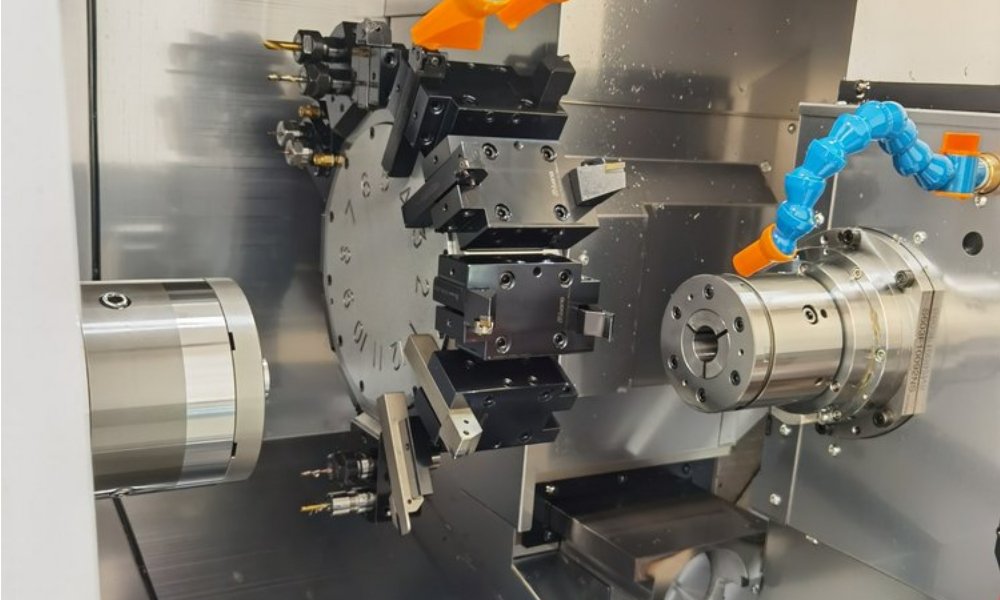
XAP Precision machines both systems daily. On turned parts, tapping and thread turning happen in cycle on CNC lathes and Swiss-type machines, so UNC vs metric threads stay gauge-accurate from first article through full production. Learn more on our CNC turning service page.
Frequently Asked Questions About UNC vs Metric Threads
Can I substitute a metric bolt for a UNC bolt with a similar diameter?
No. Although an M8 bolt and a 5/16 UNC bolt differ by only about 0.06 mm in diameter, their pitches are incompatible. The threads may engage for a few turns, then bind and strip under load. Match the thread standard of the mating part, or re-tap both sides together as a set.
Which thread system should I specify for CNC machined parts?
Choose based on where the product will be assembled and serviced. Metric coarse threads simplify sourcing for global markets, while UNC remains practical for North American service fleets. Either way, write the full callout on the drawing so your UNC vs metric threads decision never rests on assumption.
How can I identify the thread standard on an existing part?
Measure the pitch with a thread pitch gauge. Metric pitches read directly in millimeters, while inch threads match a blade marked in TPI. Confirm the diameter with calipers afterward, since a few sizes overlap between the two systems. When doubt remains, test with a calibrated ring or plug gauge.
Get a Free Quote for Threaded CNC Parts
Thread accuracy decides whether assemblies fit on the first attempt. XAP Precision produces tapped, thread-milled, and thread-turned parts in aluminum, stainless steel, brass, titanium, and engineering plastics under ISO 9001 quality management. Whether your drawing calls for UNC vs metric threads or both, send it today for a free quote plus free DFM feedback on your thread callouts. Contact us to get started.